How Fortuna Helps With PERM

PERM, the Payment Error Rate Measurement program, is how CMS measures improper payments in Medicaid and CHIP. Historically, a high rate meant a corrective action plan. Under H.R. 1, a high eligibility error rate means the federal government takes money back.
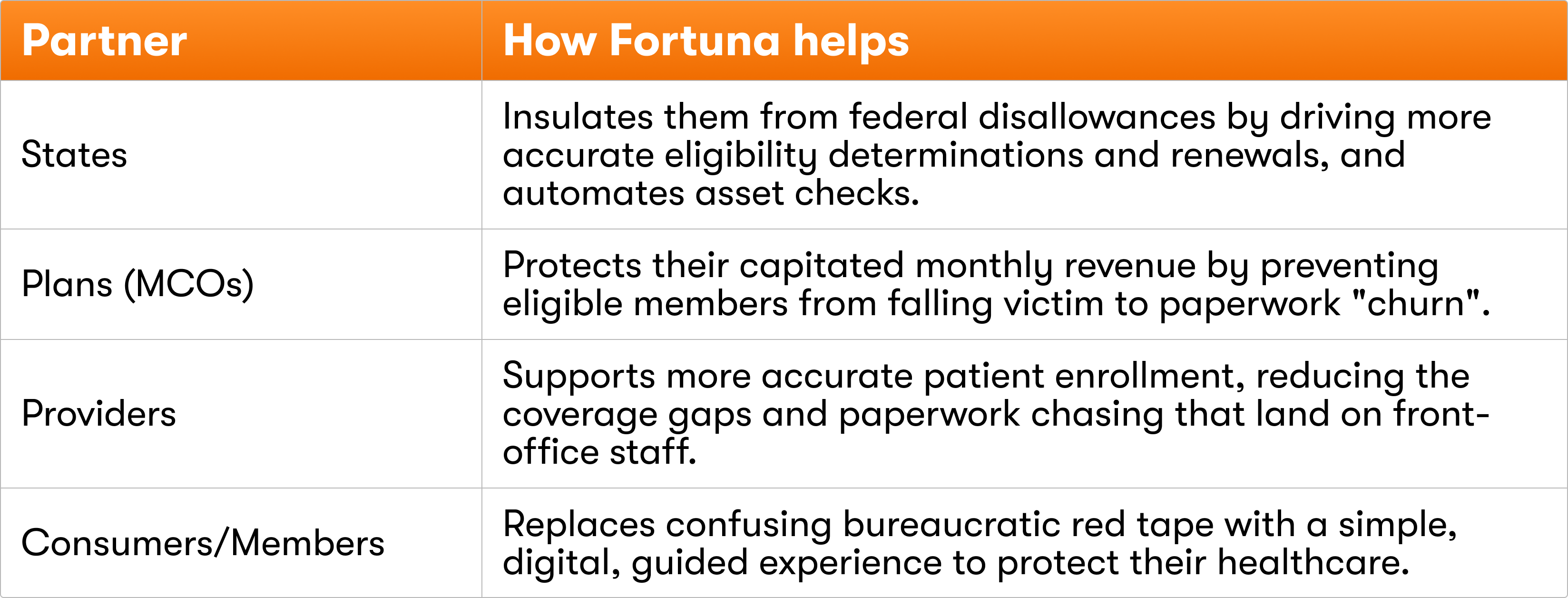
Here's what that means for every party in the program, and where Fortuna fits.
What Counts as an Improper Payment
The term is widely misunderstood. CMS defines an improper payment as one that failed to meet a statutory, regulatory, or administrative requirement - a category that covers far more paperwork than wrongdoing. Roughly 77% of improper payments come down to documentation. Improper payments can result from a variety of circumstances, including:
- Items or services with no documentation.
- Items or services with insufficient documentation.
- Items or services with documentation that does not substantiate the payment.
- Items or services where the payment went to the right recipient for the right amount, but the payment process did not comply with applicable statutory or regulatory requirements.
- With respect to Medicaid and CHIP, no record of the required verification of an individual's eligibility factors, such as income.
1. For States: Financial Risk & Payer Modernization
When a state is flagged with a high PERM rate, it triggers federal oversight.
The Penalty Threat: States have historically relied on corrective action plans to fix issues. Federal law has long allowed the recovery of eligibility-related erroneous payments above a 3% threshold, but the HHS Secretary could waive it where a state was making a good-faith effort - so in practice it was never applied.
Beginning in fiscal year 2030, which starts October 1, 2029, H.R. 1 effectively eliminates that waiver and requires the Secretary to issue eligibility-related disallowances above the threshold. Narrow exceptions remain, including for the Medicaid "spend down" group.
The Shift to Managed Care: States that lean heavily on Managed Care Organizations (MCOs) - where the state pays a flat monthly premium per member - register a 0% error rate on those payments, because CMS counts them as a flat, predictable fee. That creates a real incentive for states carrying high fee-for-service (FFS) error to move more of their Medicaid population into managed care. It only addresses the FFS component, though. The eligibility determination behind every enrollee still has to be correct and documented, capitated or not.
Perfect Beneficiary Eligibility: Eligibility errors (e.g., enrolling someone who didn't qualify) are categorized separately under the PERM Eligibility component, not Managed Care.
Heavy Tech Investments: States must upgrade aging IT systems, investing in automated asset verification, real-time data matches, and provider enrollment portals to eliminate manual paperwork bottlenecks.
2. For Managed Care Plans: New Oversight & Growth Opportunities
Managed care plans are caught directly in the crosshairs of the state's scramble to improve compliance.
Delegated Enforcement: States pass the administrative pressure downward. When a member turns out to have been enrolled in error, the capitation payments made on their behalf count as erroneous - scored under the eligibility component, not managed care - and state contracts generally let the state recoup those payments from the plan, retroactively. H.R. 1 widens that exposure: because the definition now reaches members whose eligibility simply can't be documented, a plan can lose capitation revenue for someone who was eligible all along. Provider networks carry the same risk, where contracting with a doctor the state hasn't properly revalidated invites its own clawbacks.
Massive Enrollment Influx: On the positive side, as states move away from riskier FFS models, MCOs stand to gain members as complex populations like long-term care and behavioral health get carved in.
3. For Providers: "Administrative Churn" & Audit Fatigue
Doctors, hospitals, and clinics bear the heaviest operational burden when a state reacts to a high PERM rate.
Aggressive Record Audits: When CMS pulls a state's PERM sample, providers face tight deadlines to produce pristine medical records. Fail to supply a single signed chart or proof of medical necessity and the payment is recovered, meaning providers lose revenue over technicalities rather than over care.
Burdensome Re-Enrollment: States are tightening screening requirements. Providers face rigid, redundant verification cycles, fingerprinting, and site visits to remain in the Medicaid network.
The "Medicaid Dropout" Risk: Providers absorb the cost when patient enrollment breaks down. Front-office staff spend unbilled hours helping patients track down income documents and clear renewal notices, and when a patient is dropped for a paperwork reason, care already delivered becomes uncompensated. Stricter verification makes both problems worse, and many independent or smaller practices respond by limiting or ending Medicaid participation altogether.
4. For Consumers / Members: Red Tape & "Churn" Risk
Medicaid recipients rarely hear the acronym PERM, but they feel its downstream effects directly.
The Procedural "Churn" Trap: To fix eligibility error rates, states are tightening income and residency verification. If a member misses a letter in the mail or struggles to upload a tax document to a clunky state portal, they can be dropped from the program - even if they are completely eligible. That's procedural churn, and the CBO expects the policy change to cost roughly 100,000 people their coverage as states tighten their processes to avoid penalties.
Access-to-Care Gaps: As providers exit Medicaid over audit fatigue or stricter enrollment rules, members are left with narrower networks, longer wait times, and longer travel distances for basic care.
The Bottom Line
H.R. 1 turns eligibility accuracy from a reporting exercise into a financial one, starting in fiscal year 2030. The fastest way for a state to lower its error rate is to make the front door harder to walk through, which drops eligible people alongside ineligible ones. The durable way is to make getting eligibility right the path of least resistance. That's the problem Fortuna is built to solve.
Sources: CMS, "Payment Error Rate Measurement (PERM) Program: Medicaid Improper Payment Rates" (2025); CMS FY2025 Medicaid and CHIP improper payments data; CMS Informational Bulletin on H.R. 1 Medicaid provisions (November 18, 2025); Congressional Budget Office, "Estimated Budgetary Effects of Public Law 119-21" (July 2025); Georgetown Center for Children and Families analysis of the reconciliation law (July 2025); Commonwealth Fund, "What H.R. 1's Changes to Medicaid Payment Error Rules Mean for States" (July 2026); KFF, "A Look at the Medicaid PERM Program and Upcoming Changes" (2026); Bipartisan Policy Center, "Understanding Medicaid's PERM Program and Changes Under H.R. 1" (2026).