What Stands Out in Nebraska's Medicaid Work Requirements Paperwork

On May 1, 2026, Nebraska became the first state to start Medicaid work requirements under H.R. 1. With CMS implementation guidance not due until June 1, the documents Nebraska DHHS has published - the Verification of Compliance Notice (VOCN) and the Individual Declaration Form (MLTC-118) - are the first concrete look at how a state will actually operationalize the new requirements.
Both documents are publicly available on the Nebraska DHHS work requirements page. Rather than recap them line by line, here are the details worth a closer look — things that signal how Nebraska is thinking about implementation, where the state has invested in infrastructure, and what members will actually be asked to provide.
A QR code for electronic submission
The paper declaration form includes a QR code linking to iServe.Nebraska.gov, where members can complete and submit the form electronically.

This is novel for state Medicaid paperwork, which has historically lagged on digital infrastructure. The QR code is a small visual element, but it tells you something larger: Nebraska expects digital submissions, and DHHS has built out the back-end to support them. It also reflects an awareness that members increasingly interact with state benefits through a phone, not a mailbox.
The drug treatment section asks for specifics, not a checkbox
Members claiming the substance use disorder exemption don't just check a box and move on. The form requires the facility name, facility address, contact name, contact phone number, dates of service, and whether the services were provided while the individual was enrolled with Nebraska Medicaid.

That's six discrete data points for a single exemption claim - notably more specific than the "yes/no with explanation" structure many state forms use for sensitive categories.
The depth here is consistent with how the form treats other medical exemptions: the more the state needs to verify the claim externally, the more documentation it asks for upfront.
Caregiving exemptions don't require a relative or a shared household
For both the "child 13 or younger" and "disabled individual" caregiver exemptions, the form asks two yes/no gateway questions: is the care recipient a relative, and do they live in your household?
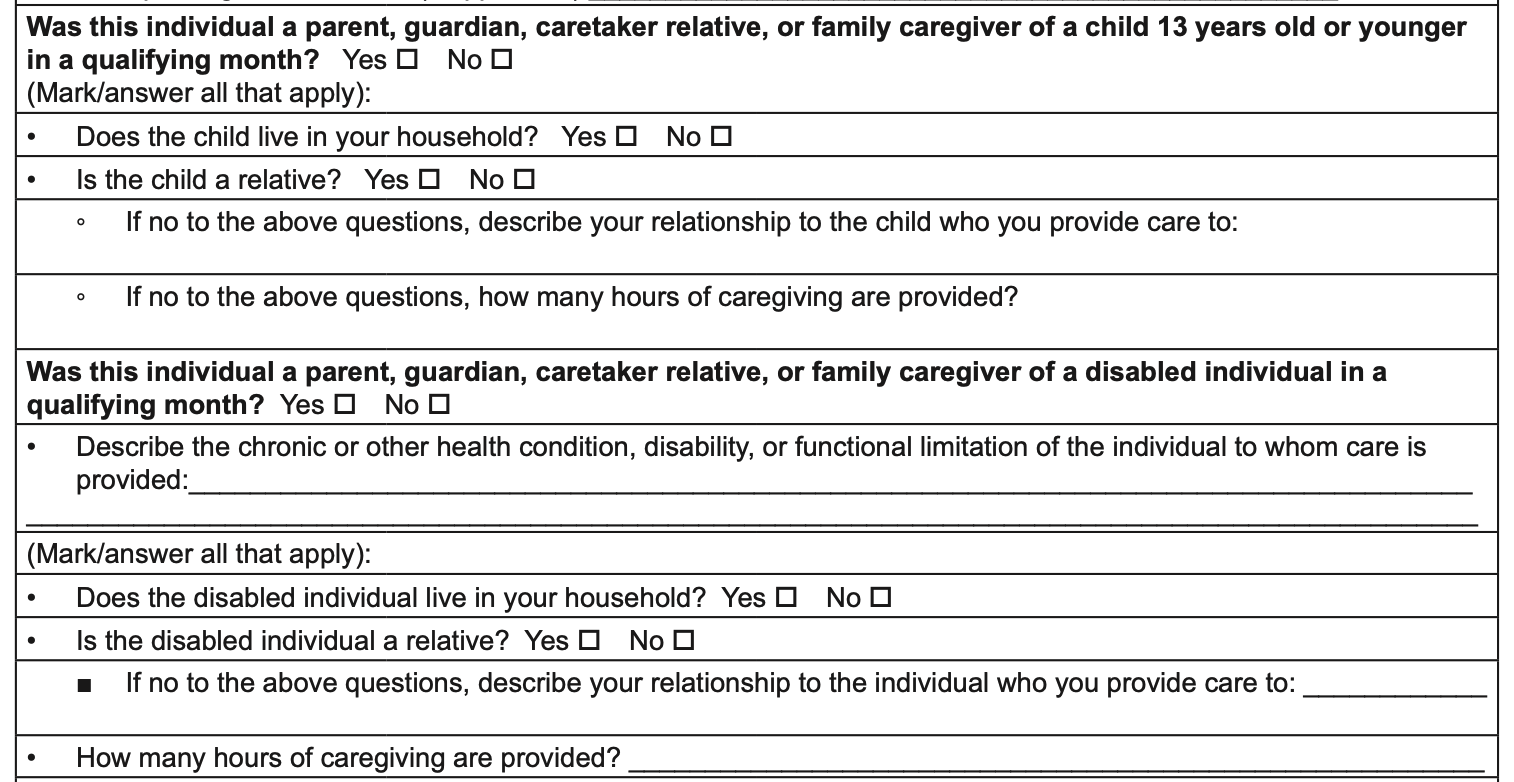
If the answer to both is no, members can still claim the exemption - they just have to describe the relationship and document the hours of caregiving provided. That's broader than the typical "parent of a minor child" framing and accommodates kin, neighbor caregiving, and other informal arrangements that can go unrecognized in benefits paperwork.
The form has a signature line for "Person Who Helped"
Below the member's signature, the form includes a second labeled signature line: Signature and Relationship of Person Who Helped.

This formalizes the role of family members, navigators, and community-based organizations in completing the form - and creates a paper trail of who assisted. The presence of the line, before any helper involvement actually occurs, signals that DHHS anticipates a share of members will need support.
What's not on the form is also informative
The VOCN enumerates twelve exemption categories. The declaration form has attestation sections for only seven of them.

Absent from the declaration form: tribal affiliation, TANF compliance, SNAP work rule alignment, foster-care youth status, and pregnancy/postpartum. These are presumably verified through Nebraska's existing data systems - meaning members who qualify on those grounds don't need to fill out a form at all. The form covers exactly the categories the state can't easily cross-check elsewhere.
Every medical exemption asks: "while enrolled with Nebraska Medicaid?"
Four sections of the form - medical frailty, drug/alcohol treatment, inpatient hospital services, and medical travel - include the same follow-up question: were the services provided while the member was enrolled in Nebraska Medicaid?

This is a quiet but consequential structural detail. Attestation is typically thought of as a fallback for when claims data isn't available - but the "while enrolled?" question gives it a second function: surfacing where the state's own data may be incomplete or lagging. When a member attests "yes, this happened while I was enrolled in Nebraska Medicaid" but the claim doesn't appear in the state's records, that mismatch is itself useful information - a signal of where data systems can be tightened. Over time, that feedback loop is part of how Nebraska's verification process is likely to become more automated.
Medical travel claims require a written "reason for travel"
The exemption for traveling outside the community for serious medical care isn't structured as a simple yes/no. Members must provide the facility name, address, dates of service, the condition being treated, and a written explanation of the reason for travel outside the individual's community.
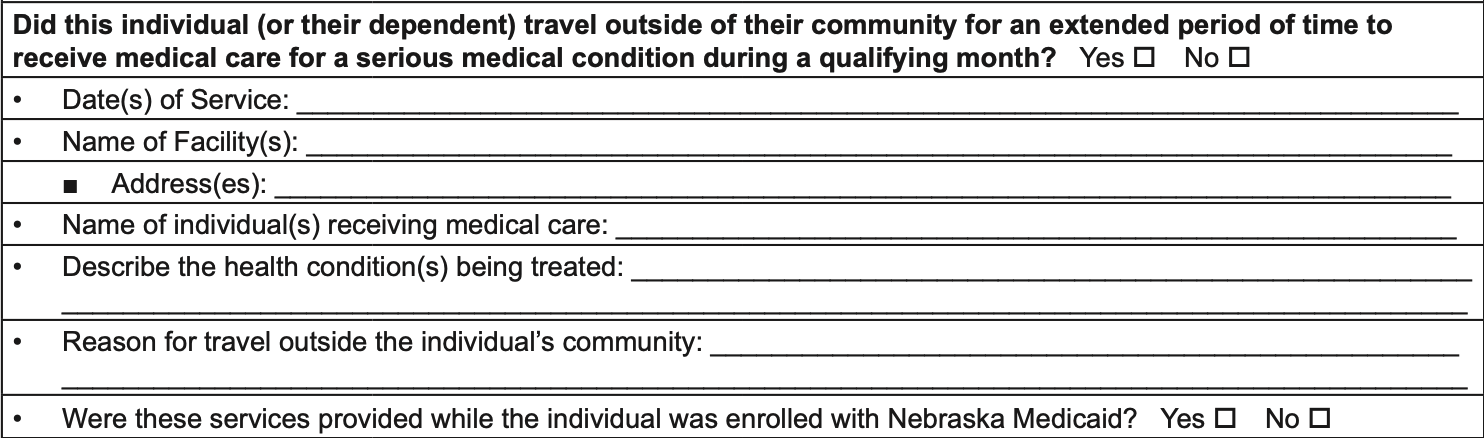
The narrative requirement is unusual on a benefits form, and it signals that DHHS will evaluate these claims case-by-case rather than algorithmically. It also implies that proximity to specialty care is something the state wants to understand qualitatively - not just verify that a trip happened.
What this signals overall
A few themes connect these details:
- Digital-first infrastructure. The QR code, iServe portal, and electronic submission options suggest Nebraska expects - and is built for - digital-first interaction with members.
- Documentation depth scales with verifiability. Categories the state can't cross-check elsewhere (substance use treatment, medical frailty, informal caregiving) require the most member-provided information.
- The system is designed with assistance in mind. The "Person Who Helped" signature line and multiple submission channels suggest DHHS anticipates that many members will need support completing the process.
- This is version 1.0. Nebraska has signaled it will refine the process over time - including moving toward more automated verification.
We'll continue tracking how each state's approach compares as the first full implementation cycle plays out.
Nebraska's digital-first approach is an early indicator of where member-facing Medicaid infrastructure is heading. If your team is designing similar systems for work requirements compliance or rethinking how members interact with renewals, eligibility, and verifications more broadly — Fortuna is helping health plans and MCOs build out these digital strategies. Reach out to our team for more information!
Source documents:
- Verification of Compliance Notice (Sample)
- Individual Declaration Form (MLTC-118)
- Nebraska DHHS Work Requirements Page